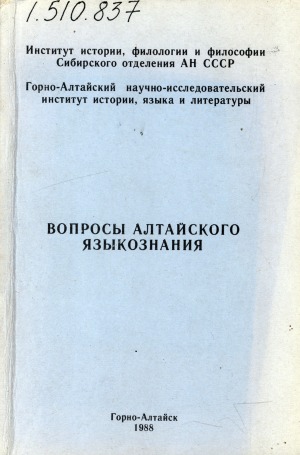

Количество страниц: 15 с.
- Языкознание. Филология. Художественная литература > Языкознание и языки. Лингвистика > Якутский (саха),
- Языкознание. Филология. Художественная литература > Языкознание и языки. Лингвистика > Тюркские языки,
- НАУКА ЯКУТИИ > ЯЗЫКОЗНАНИЕ. ФИЛОЛОГИЯ. ЛИТЕРАТУРОВЕДЕНИЕ. ХУДОЖЕСТВЕННАЯ ЛИТЕРАТУРА > Языкознание и языки. Лингвистика.
In modern times, the functioning of languages in public space requires state regulation, the main goal of which should be the preservation and development of multilingualism and support of minority languages. The national politics in the field of preservation and development of the languages of the peoples of the Russian Federation is based on the implementation of a number of measures at the legislative level. Russia adopted the Law “On the Languages of the Peoples of the Russian Federation”; its national republics have their own laws on languages regulating the functioning of languages on their territory. In Yakutia, on October 16, 1992, Law of the Republic of Sakha (Yakutia) No. 1170-XII “On languages in the Republic of Sakha (Yakutia)” was adopted, a study on the implementation of which became one of the projects of the state program of the Republic of Sakha (Yakutia) “Preservation and development of state and official languages in the Republic of Sakha (Yakutia) for 2023.” The project “Monitoring the implementation and compliance with the requirements of articles of the Law on Languages in Yakutsk of the Republic of Sakha (Yakutia)” was proposed by the Department of Stylistics of the Yakut Language and Russian-Yakut Translation of the Institute of Languages and Culture of the North-East of the Russian Federation of the M.K. Ammosov North-Eastern Federal University. In order to implement the project, the department’s team developed a questionnaire on the articles of the Law “On Languages in the Republic of Sakha (Yakutia)” for two target audiences: specialists from organizations to whose work the articles of the Law are directly related, and the population. The purpose of the proposed work is to analyze the results of a survey conducted on articles 19, 20, 21, 22, 23, 33 among specialists of organizations and the population of the city of Yakutsk. The study used statistical and descriptive methods, as well as data processing and analysis methods. The results of the study are structured as follows: first, the full text of the considered article of the Law “On Languages in the Republic of Sakha (Yakutia)” is presented, then an analysis of a survey among employees of the institution and the results of a survey among the population are presented, followed by recommendations for the implementation of the article of the Law.
Собакина, И. В. К вопросу о функционировании Закона "О языках в Республике Саха (Якутия)" в городе Якутске (на материале результатов анкетирования по статьям 19-23, 33) / И. В. Собакина ; Северо-Восточный федеральный университет им. М. К. Аммосова, Институт языкови культуры народов Северо-Востока Российской Федерации // Вестник Северо-Восточного федерального университета им. М. К. Аммосова. Серия "Алтаистика". - 2024. - N 1 (12). - C. 26-40. - DOI: 10.25587/2782-6627-2024-1-26-40
DOI: 10.25587/2782-6627-2024-1-26-40
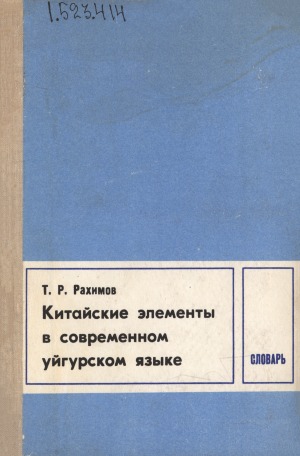
Издательство: Наука, Главная редакция восточной литературы
Год выпуска: 1970
Количество страниц: 380 с.

Издательство: Издание МИВ
Год выпуска: 1940
Количество страниц: 158 с.

Издательство: Наука
Год выпуска: 1981
Количество страниц: 140 с.

Количество страниц: 18 с.
From the card index “Phraseologisms characterising a human being in Yakut and Turkic languages of South Siberia, Turkish and Kazakh” compiled by the author, 75 lexeme-mongolisms in the Yakut language were identified. This article is the first special study of these lexemes-mongolisms, which are part of Yakut phraseologisms (somatisms; lexemes denoting objects of material culture). The aim of this study is to identify the area of distribution of Mongolisms included in Yakut phraseological phrases, to establish phraseological parallels in other Turkic languages, to determine the motivational bases of phraseological phrases characterising human beings. Thus, to make a certain contribution to the clarification of the problem of Yakut-Mongolian contacts. The value of phraseologisms lies in the fact that remaining unchanged, they preserve national identity and reflect the characteristic features of the historical epoch in which they originated. The study of Mongolisms in the Yakut language is based on the scientific works of E.I. Ubryatova, S. Kaluzhinsky, V.I. Rassadin, N.N. Shirobokova, N.K. Antonov, G.G. Levin, A.E. Shamaeva and others. As a result of the study, it was established that: Mongolisms included in Yakut phraseologisms can be subdivided into the following types - a) Mongolisms borrowed by the Turkic-speaking ancestors of the Yakuts back in the times when they lived in the “southern” ancestral homeland; b) Mongolisms previously acquired in the “southern” ancestral homeland as part of the Turkic Kypchak component; c) Mongolisms that penetrated already in geographically separated groups of Turkic languages from certain Mongolian languages; d) Mongolisms acquired through an “unknown” Middle Mongolian source language and/or Buryat language. The overwhelming majority of the considered Yakut phraseologisms with Mongolian components do not find parallels in the Turkic languages, which confirms the thesis that the formation of these phraseologisms took place in the process of their development under conditions of non-contact with the Turkic languages of South Siberia. The prospects of the study are seen in further reconstruction of the phraseological fund of the Yakut language in order to make a significant contribution to the solution of the problem of Yakut-Mongolian contacts.
Анисимов, Р. Н. Монгольские компоненты в составе якутских фразеологизмов, характеризующих человека (сравнительно-сопоставительный аспект) / Р. Н. Анисимов ; Северо-Восточный федеральный университет им. М. К. Аммосова // Вестник Северо-Восточного федерального университета им. М. К. Аммосова. - 2024. - Т. 21, N 1 (95). - С. 98-115. - DOI: 10.25587/2222-5404-2024-21-1-98-115
DOI: 10.25587/2222-5404-2024-21-1-98-115

Издательство: АН Казахской ССР
Год выпуска: 1958
Количество страниц: 260 с.

Издательство: Наука
Год выпуска: 1970
Серия, номер выпуска: Ч. 2
Количество страниц: 182 с.

Издательство: Наука, Ленинградское отделение
Год выпуска: 1971
Количество страниц: 412 с.
Год выпуска: 2023